
By Zohaib Nawaz3 min read
Thirty minutes: what I wish I had known about asking for help
In my first months as a developer I would stay stuck on one problem for a whole day before admitting it. Pride felt like professionalism. It wasn't. This is the simple rule that changed how I work, and how I feel about work.
On this page
In my first months at my first job, I would sit with a single bug for an entire day.
Not because I enjoyed it. Because asking felt like confessing that I did not belong there. I would open a chat with a senior developer, type out a message, read it twice, and delete it. “Let me try one more thing first.” Then another thing. Then it was evening, the bug was still there, and I had a headache and nothing to show for it.
What I thought I was protecting
In my head, a good developer was someone who figured everything out alone. Every question I asked was a small piece of evidence that I was not good enough. So I kept the questions to myself and tried to look busy and capable.
The strange part is that nobody was watching that closely. The image I was protecting existed mostly in my own head. What people could see was much simpler: a task that should have taken an hour was taking a day.
More than once, when I finally gave up and asked, the answer came back in two minutes. A missing environment variable. A config file that every new person gets wrong. Something the senior had already fixed for three other people. A whole day of silence, undone by one short message.
The code review that stung
I still remember one of my early pull requests coming back with a long list of comments. I read them on my phone at night, lying in bed, and every comment felt like a small stone. I felt slow. I felt like I had wasted someone's time.
The next morning I read them again with fresh eyes, and something shifted. None of the comments were about me. They were about the code. Each one was a lesson that someone had taken the time to write down, specifically for me, for free. That is not rejection. That is somebody investing in you.
I started saving the comments I received most often in a small notes file. Within a few months, the same comments stopped appearing. That file taught me more than any course I had paid for.
The thirty-minute rule
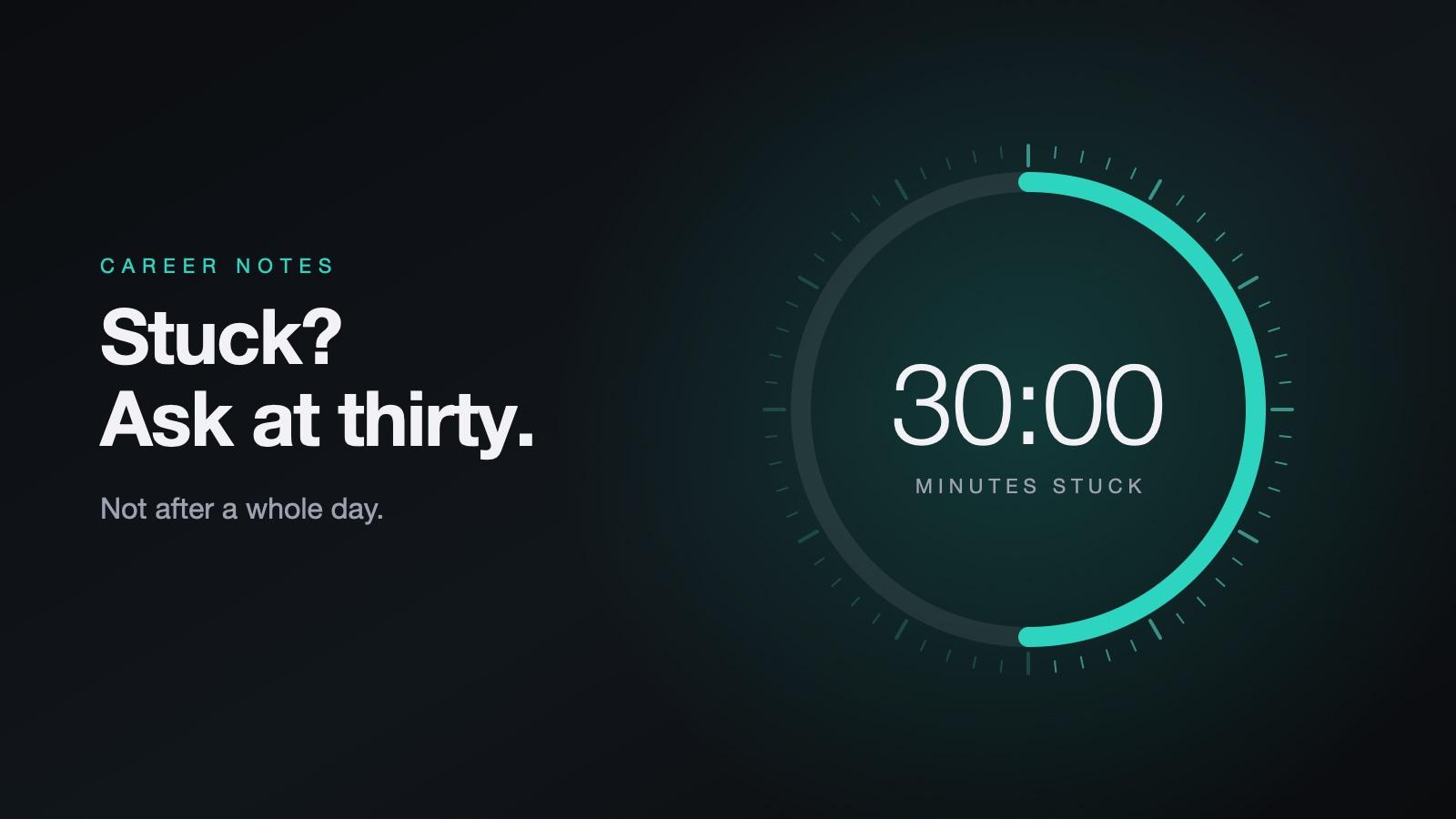
The rule I follow now is simple. If I am stuck for thirty minutes and I have not learned anything new in that time, I ask. Not after a day. Not after “one more thing.” Thirty minutes.
But I try to ask well. Every question I send now has four parts:
- What I am trying to do.
- What I expected to happen.
- What actually happened, with the exact error.
- What I have already tried.
A question like that respects the other person's time, because they don't have to pull the context out of me one line at a time.
And here is the quiet magic of it: about half the time, while writing the question out properly, I find the answer myself and never send it. The other half of the time, I get help much faster, because the question is already clear.
Stuck for thirty minutes with nothing new learned? Write the message.
What I would tell myself a year and a half ago
Not knowing is the job. The experienced developers around you are not the ones who know everything. They are the ones who ask questions quickly, without apologising, and move on.
Your value is not measured by how long you can suffer alone in silence. It is measured by what you ship, how you treat the people you work with, and how quickly you learn. Asking for help helps all three.
If you are new and you are reading this while stuck on something right now, check the clock. If it has been thirty minutes, write the message. Send it this time.
And if you want to talk about any of this, my inbox is open.